


Page 4 - Demo
P. 4
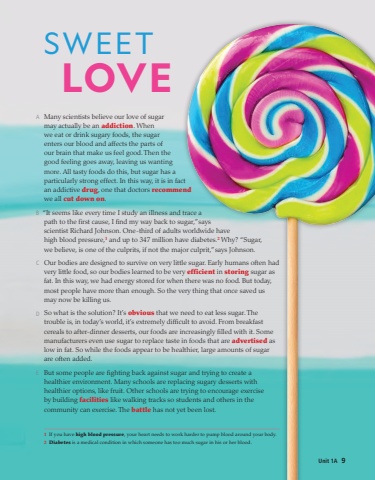
SWEETLOVEMany scientists believe our love of sugar may actually be an addiction. When we eat or drink sugary foods, the sugar enters our blood and affects the parts of our brain that make us feel good. Then the good feeling goes away, leaving us wanting more. All tasty foods do this, but sugar has a particularly strong effect. In this way, it is in fact an addictive drug, one that doctors recommendwe all cutdownon.%u201cIt seems like every time I study an illness and trace a path to the first cause, I find my way back to sugar,%u201d says scientist Richard Johnson. One-third of adults worldwide have high blood pressure,1 and up to 347 million have diabetes.2 Why? %u201cSugar, we believe, is one of the culprits, if not the major culprit,%u201d says Johnson.Our bodies are designed to survive on very little sugar. Early humans often had very little food, so our bodies learned to be very efficient in storing sugar as fat. In this way, we had energy stored for when there was no food. But today, most people have more than enough. So the very thing that once saved us may now be killing us.So what is the solution? It%u2019s obvious that we need to eat less sugar. The trouble is, in today%u2019s world, it%u2019s extremely difficult to avoid. From breakfast cereals to after-dinner desserts, our foods are increasingly filled with it. Some manufacturers even use sugar to replace taste in foods that are advertised as low in fat. So while the foods appear to be healthier, large amounts of sugar are often added.But some people are fighting back against sugar and trying to create a healthier environment. Many schools are replacing sugary desserts with healthier options, like fruit. Other schools are trying to encourage exercise by building facilities like walking tracks so students and others in the community can exercise. The battle has not yet been lost.ABCDE1If you have highbloodpressure, your heart needs to work harder to pump blood around your body.2Diabetes is a medical condition in which someone has too much sugar in his or her blood.Unit 1A9


