


Page 49 - Demo
P. 49
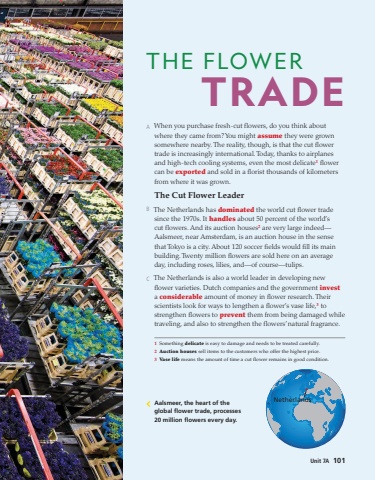
THE FLOWERTRADEWhen you purchase fresh-cut flowers, do you think about where they came from? You might assume they were grown somewhere nearby. The reality, though, is that the cut flower trade is increasingly international. Today, thanks to airplanes and high-tech cooling systems, even the most delicate1 flower can be exported and sold in a florist thousands of kilometers from where it was grown.The Cut Flower LeaderThe Netherlands hasdominated the world cut flower trade since the 1970s. Ithandles about 50 percent of the world%u2019s cut flowers. And its auction houses2 are very large indeed%u2014Aalsmeer, near Amsterdam, is an auction house in the sense that Tokyo is a city. About 120 soccer fields would fill its main building. Twenty million flowers are sold here on an average day, including roses, lilies, and%u2014of course%u2014tulips. The Netherlands is also a world leader in developing new flower varieties. Dutch companies and the government a considerable amount of money in flower research. Their scientists look for ways to lengthen a flower%u2019s vase life,strengthen flowers to prevent them from being damaged while traveling, and also to strengthen the flowers%u2019 natural fragrance.1Somethingdelicate is easy to damage and needs to be treated carefully.2Auction houses sell items to the customers who offer the highest price.3Vase life means the amount of time a cut flower remains in good condition.ABCNetherlandsAalsmeer, the heart of the global flower trade, processes 20 million flowers every day.Unit 7A


