


Page 26 - Demo
P. 26
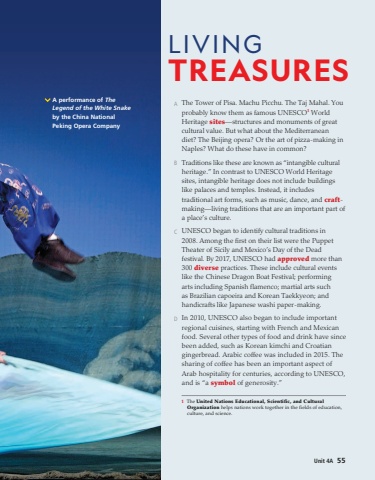
LIVINGTREASURESAB CDThe Tower of Pisa. Machu Picchu. The Taj Mahal. You probably know them as famous%u00a0UNESCO1 World Heritage sites%u2014structures and monuments of great cultural value. But what about the%u00a0Mediterranean diet? The%u00a0Beijing opera? Or the art of pizza-making in Naples? What do these have in common?Traditions like these are known as %u201cintangible cultural heritage.%u201d In contrast to UNESCO World Heritage sites, intangible heritage does not include buildings like palaces and temples. Instead, it includes traditional art forms, such as music, dance, and craftmaking%u2014living traditions that are an important part of a place%u2019s culture. UNESCO began to identify cultural traditions in 2008. Among the first on their list were the Puppet Theater of Sicily and Mexico%u2019s%u00a0Day of the Dead festival. By 2017, UNESCO had approved more than 300 diverse practices. These include cultural events like the Chinese Dragon Boat Festival; performing arts including Spanish flamenco; martial arts such as Brazilian capoeira and Korean Taekkyeon; and handicrafts like Japanese washi paper-making.In 2010, UNESCO also began to include important regional cuisines, starting with French and Mexican food. Several other types of food and drink have since been added, such as Korean kimchi and Croatian gingerbread. Arabic coffee was included in 2015. The sharing of coffee has been an important aspect of Arab hospitality for centuries, according to UNESCO, and is %u201ca symbol of generosity.%u201d A performance of The Legend of the White Snakeby the China National Peking Opera Company1The United Nations Educational, Scientific, and Cultural Organization helps nations work together in the fields of education, culture, and science.Unit 4A


