


Page 64 - Demo
P. 64
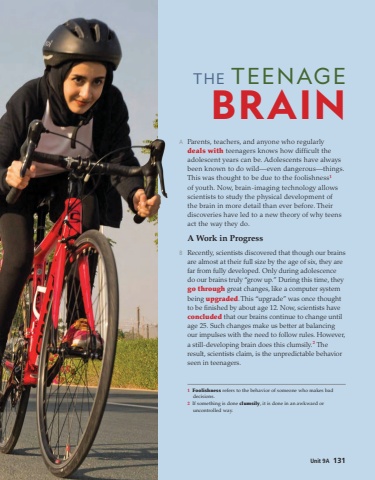
Parents, teachers, and anyone who regularlydealswith teenagers knows how difficult the adolescent years can be. Adolescents have always been known to do wild%u2014even dangerous%u2014things. This was thought to be due to the foolishnessof youth. Now, brain-imaging technology allows scientists to study the physical development of the brain in more detail than ever before. Their discoveries have led to a new theory of why teens act the way they do.A Work in ProgressRecently, scientists discovered that though our brains are almost at their full size by the age of six, they are far from fully developed. Only during adolescence do our brains truly %u201cgrow up.%u201d During this time, they go through great changes, like a computer system being upgraded. This %u201cupgrade%u201d was once thought to be finished by about age 12. Now, scientists have concluded that our brains continue to change until age 25. Such changes make us better at balancing our impulses with the need to follow rules. However, a still-developing brain does thisclumsily.2 The result, scientists claim, is the unpredictable behavior seen in teenagers.AB1Foolishness refers to the behavior of someone who makes bad decisions.2If something is done clumsily, it is done in an awkward oruncontrolled way.Unit 9ATHE TEENAGEBRAIN


