


Page 65 - Demo
P. 65
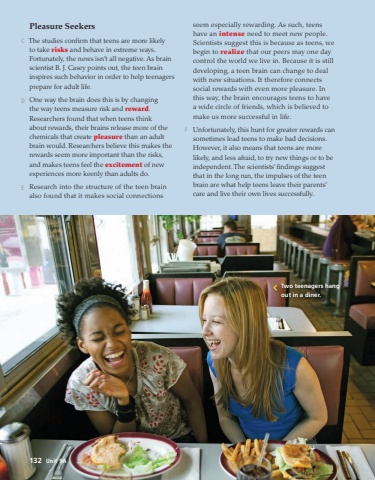
Pleasure SeekersThe studies confirm that teens are more likely to take risks and behave in extreme ways. Fortunately, the news isn%u2019t all negative. As brain scientist B. J. Casey points out, the teen brain inspires such behavior in order to help teenagers prepare for adult life.One way the brain does this is by changing the way teens measure risk and reward. Researchers found that when teens think about rewards, their brains release more of the chemicals that create pleasure than an adult brain would. Researchers believe this makes the rewards seem more important than the risks, and makes teens feel the excitement of new experiences more keenly than adults do.Research into the structure of the teen brain also found that it makes social connections CDEseem especially rewarding. As such, teens have an intense need to meet new people. Scientists suggest this is because as teens, we begin to realize that our peers may one day control the world we live in. Because it is still developing, a teen brain can change to deal with new situations. It therefore connects social rewards with even more pleasure. In this way, the brain encourages teens to have a wide circle of friends, which is believed to make us more successful in life.Unfortunately, this hunt for greater rewards can sometimes lead teens to make bad decisions. However, it also means that teens are more likely, and less afraid, to try new things or to be independent. The scientists%u2019 findings suggest that in the long run, the impulses of the teen brain are what help teens leave their parents%u2019 care and live their own lives successfully.F132Unit 9A


