


Page 78 - Demo
P. 78
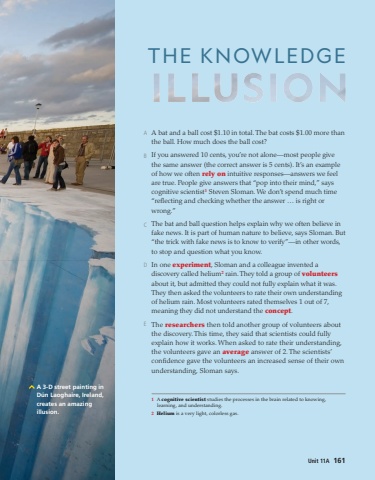
illusion.THE KNOWLEDGEA bat and a ball cost $1.10 in total. The bat costs $1.00 more than the ball. How much does the ball cost?If you answered 10 cents, you%u2019re not alone%u2014most people give the same answer (the correct answer is 5 cents). It%u2019s an example of how we often rely onintuitive responses%u2014answers we feel are true. People give answers that %u201cpop into their mind,%u201d says cognitive scientist1 Steven Sloman. We don%u2019t spend much time %u201creflecting and checking whether the answer %u2026 is right or wrong.%u201dThe bat and ball question helps explain why we often believe in fake news. It is part of human nature to believe, says Sloman. But %u201cthe trick with fake news is to know to verify%u201d%u2014in other words, to stop and question what you know.In one experiment, Sloman and a colleague invented a discovery called helium2 rain. They told a group of volunteersabout it, but admitted they could not fully explain what it was. They then asked the volunteers to rate their own understanding of helium rain. Most volunteers rated themselves 1 out of 7, meaning they did not understand the concept.The researchers then told another group of volunteers about the discovery. This time, they said that scientists could fully explain how it works. When asked to rate their understanding, the volunteers gave an average answer of 2. The scientists%u2019 confidence gave the volunteers an increased sense of their own understanding, Sloman says.ABCDE1A cognitive scientist studies the processes in the brain related to knowing, learning, and understanding.2Heliumis a very light, colorless gas.Unit 11A


