


Page 79 - Demo
P. 79
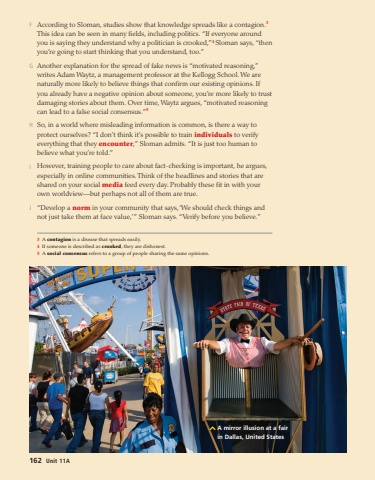
According to Sloman, studies show that knowledge spreads like a contagion.3This idea can be seen in many fields, including politics. %u201cIf everyone around you is saying they understand why a politician is crooked,%u201d4Sloman says, %u201cthen you%u2019re going to start thinking that you understand, too.%u201dAnother explanation for the spread of fake news is %u201cmotivated reasoning,%u201d writes Adam Waytz, a management professor at the Kellogg School. We are naturally more likely to believe things that confirm our existing opinions. If you already have a negative opinion about someone, you%u2019re more likely to trust damaging stories about them. Over time, Waytz argues, %u201cmotivated reasoning can lead to a false social consensus.%u201d5 So, in a world where misleading information is common, is there a way to protect ourselves? %u201cI don%u2019t think it%u2019s possible to train individuals to verify everything that they encounter,%u201d Sloman admits. %u201cIt is just too human to believe what you%u2019re told.%u201dHowever, training people to care about fact-checking is important, he argues, especially in online communities. Think of the headlines and stories that are shared on your social media feed every day. Probably these fit in with your own worldview%u2014but perhaps not all of them are true.%u201cDevelop a norm in your community that says, %u2018We should check things and not just take them at face value,%u2019%u201d Sloman says. %u201cVerify before you believe.%u201dFGHIJ3A contagionis a disease that spreads easily.4If someone is described as crooked, they are dishonest.5A social consensusrefers to a group of people sharing the same opinions.A mirror illusion at a fair in Dallas, United States162Unit 11A


